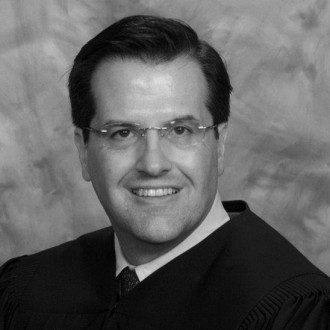
By Adrienne Rockenhaus
In 2023, the U.S. Court of Appeals for the Sixth Circuit sent a clear message to Detroit’s federal bench: judges cannot govern by personal grievance. The court vacated the conviction of Leron Liggins because U.S. District Judge Stephen J. Murphy III had abandoned his neutral role, stating the defendant “looks like a criminal to me.” The appellate panel called this conduct “wholly incompatible with the fair administration of justice.”
If the Sixth Circuit District of Appeals thought Judge Murphy would learn from their message… they thought wrong.
Two years later, Judge Murphy is presiding over my husband Conrad Rockenhaus’s case, and the record proves he has not learned a thing. In fact, his behavior has escalated. While he judged Mr. Liggins on his appearance, he is judging my husband, a disabled Navy veteran, based on my refusal to stay silent about the abuse we have suffered at the hands of his officers.
The parallel between these two cases is undeniable, and it reveals a judge who views the courtroom not as a hall of justice, but as a personal fiefdom where he punishes those who annoy him.
The Warning: United States v. Liggins (2023)
In August 2023, multiple outlets reported on the Sixth Circuit’s rare rebuke of Judge Murphy. He had become frustrated with procedural delays in Mr. Liggins’s case and lashed out in open court, saying, “I’m tired of this case… I’m tired of this defendant.” He then delivered the line that cost him the case: “This guy looks like a criminal to me.”
The appellate court found that these remarks raised “the specter of bias” so severe that it made fair judgment impossible.
As Robert Snell reported in The Detroit News, the court ruled that such “personal and condemnatory remarks” shattered the appearance of justice.
Chang Che at The New York Times noted that a “reasonable observer” could only interpret these words as prejudice.
Nate Raymond at Reuters highlighted that allowing the conviction to stand would “substantially undermine the public’s confidence in the judicial process”.
Judge Murphy apologized at the time, claiming he simply “lost his head” and that his anger didn’t mean he was biased. But his actions in my husband’s case prove that Liggins was not a one-off. It is his standard operating procedure.
The Violation: United States v. Rockenhaus (2025)
On October 14, 2025, Judge Murphy sat on the bench to determine the fate of my husband, Conrad Rockenhaus. But instead of focusing on Conrad, he focused on me.
Earlier that month, I had filed a Bivens civil rights lawsuit against a U.S. Marshal for sexual harassment and a violent, illegal raid on our home. I also filed a judicial misconduct complaint regarding the handling of our case. These were legal, protected acts to report abuse.
In the transcript of that hearing, Judge Murphy didn’t hide his personal feelings; he centered them. He announced he was “quite surprised” to see a complaint filed against him by me. He then openly weighed my legal filings against my husband’s freedom.
Judge Stephen J. Murphy III stated that if he sentenced my husband, Conrad Rockenhaus, to jail, “that’s looks like I’m penalizing him for his wife’s behavior,” but if he showed leniency, it would look like he was “intimidated by the filings”.
He explicitly framed my reports of sexual harassment and violence as “behavior” that complicated his job.
Just as he was “tired” of Mr. Liggins, he made it clear he was personally compromised by me.
The Pattern: From “Looks Like a Criminal” to “Wife’s Behavior”
When you look at the reporting on Liggins side-by-side with the Rockenhaus transcript, the pattern of judicial misconduct is stark.
- Robert Snell (The Detroit News) reported that the Sixth Circuit found Murphy’s “deep-seated antagonism” in Liggins impossible to reconcile with a fair trial. In my husband’s case, Murphy committed an even more explicit transgression. Instead of judging Conrad on his merits, he openly calculated sentencing based on “his wife’s behavior.” Just as Snell highlighted that a judge cannot permit personal remarks to infect a proceeding, the October 14 transcript proves Murphy has once again centered his own grievances over the law.
- Chang Che (The New York Times) noted that Murphy’s comments in Liggins violated due process rights by replacing neutrality with hostility. In Rockenhaus, Murphy abandoned neutrality to protect the system’s reputation over a defendant’s rights. By worrying aloud that leniency would make him look “intimidated” by my lawsuit, he admitted that his sentencing calculation was being driven by his ego and his reaction to a whistleblower, not by the statute.
- Doha Madani (NBC News) reported that Murphy justified his outburst in Liggins by claiming he was “tired” of the defendant causing delays. In our hearing, the source of his grievance wasn’t a delay, it was my constitutional right to report that a U.S. Marshal had sexually harassed me and threatened my family. By labeling this “behavior,” Murphy stripped the abuse of its legal weight and reduced it to a nuisance he had to manage.
- Ed White (AP) reported that the Liggins conviction was tossed because it undermined “public confidence”. If a comment about appearance undermines confidence, what does it do to the public trust when a judge admits he is weighing a spouse’s whistleblowing against a veteran’s liberty? Judge Murphy proved that his personal resentment toward me was a factor in my husband’s punishment.
The Conclusion
In 2023, the system gave Judge Stephen J. Murphy III a second chance. He promised he wasn’t biased; he promised it was just a mistake.
The Rockenhaus case proves that was a lie. He has not stopped letting his personal feelings dictate his rulings; he has just found a new target. This time, he isn’t just basing judgment on a defendant’s appearance, he is actively retaliating against a family for exposing misconduct within his own court.
Justice cannot exist where a judge’s ego weighs more than the law. Judge Murphy failed the test in Liggins, and he is failing it again right now.