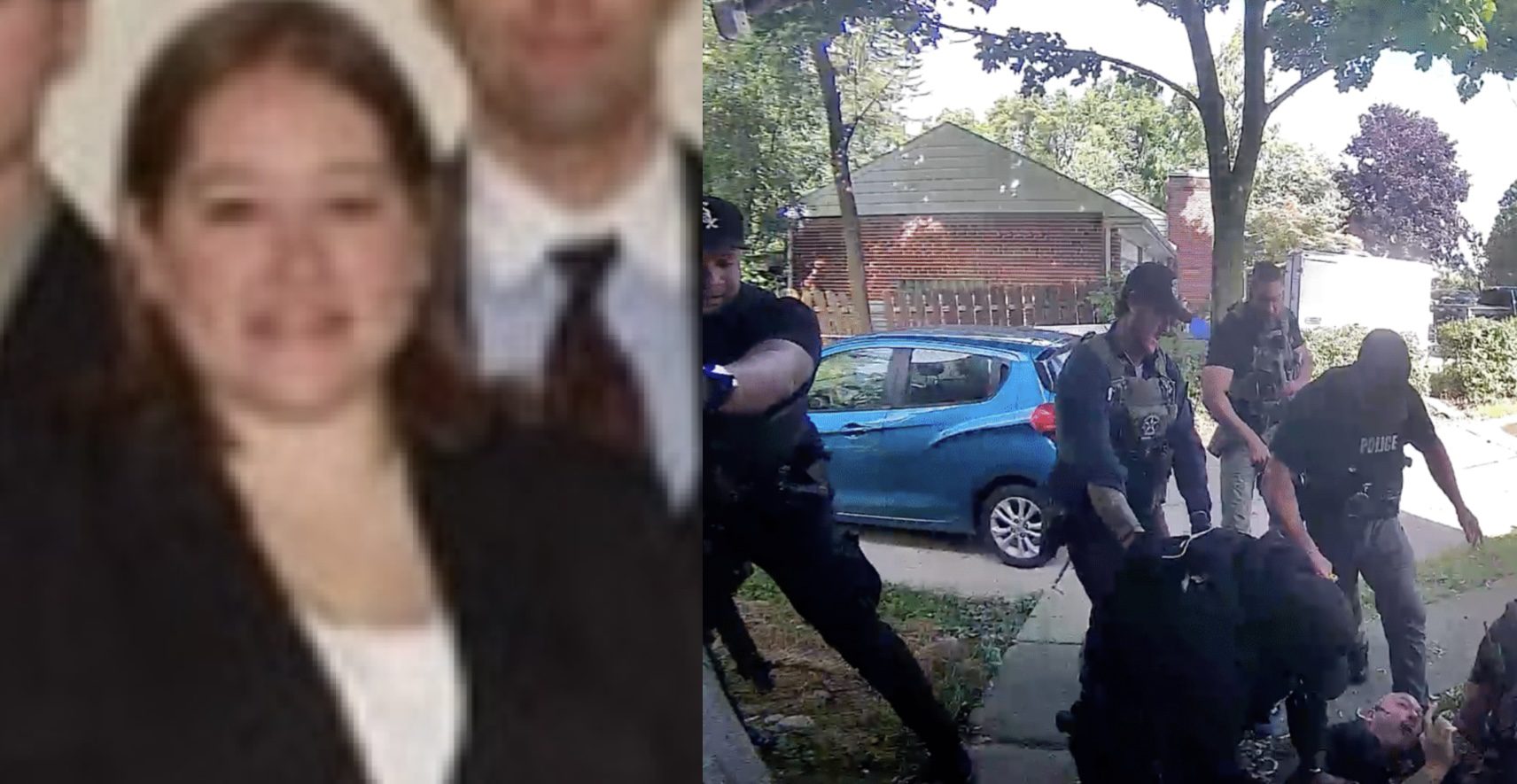

Photo: Corinne Lambert at the 2010 Michigan bar admission ceremony (John Meiu / LegalNews). This is the only publicly available image of Lambert.
Update – Sept 7, 2026: Disabled veteran, Conrad Rockenhaus, was killed in April, 2026, as a direct consequence of federal prosecutor Corinne Lambert’s predatory prosecution, active suppression of his critical brain injury (TBI) records, and subsequent perjury to the Sixth Circuit Court of Appeals.
Please click here to read the forensic report detailing Conrad’s death and the prosecutorial cover-up.
Caught on the Record: Defense Brief Proves SAUSA Corinne Lambert Misled the Court
BREAKING, DETROIT, December 23, 2025 – Lambert’s Narrative Dismantled on the Docket:
In a filing yesterday, SAUSA Corinne Lambert attempted to convince the Sixth Circuit that Conrad’s claims of medical neglect and retaliation were never raised in the lower court. Today, Defense Attorney, Kaycee Berente, responded with the transcripts. Ms. Berente filed a Reply Brief citing the specific records proving Judge Stephen J. Murphy III was fully aware of the crisis and ignored it.
The brief also places the core issue on the permanent record: Conrad’s sentence was not standard justice, but “retaliation for whistleblowing” on misconduct at the detention center. Lambert argued the Judge used “discretion”; the evidence proves he used his power to silence a whistleblower.
FACT CHECK: The “Stable Employment” Contradiction – The Prosecution’s Claim
SAUSA Corinne Lambert argues Conrad should have paid restitution because he had “stable employment with his wife’s company.”
The Prosecution’s Action: Probation seized the very devices (iPhone/Watch for app development) Conrad Rockenhaus used to perform that employment.
The Reality: The Government labeled these as “personal devices” to justify the seizure, conveniently ignoring that they were essential hardware for his role at a digital media company.
The devices were APPROVED BY A PRIOR PROBATION OFFICER. SAUSA Corinne Lambert was repeatedly served this evidence and was entirely aware of the truth.
SAUSA Corinne Lambert did not have a momentary lapse in judgment, but rather, she made a series of deliberate and conscious choices to ignore the facts and lie to the court.
You cannot demand a defendant maintain “stable employment” while confiscating the only tools he has to do the job.
SAUSA Corinne Lambert chastises Conrad Rockenhaus for not paying restitution because he had “stable employment with his wife’s company,” knowing full well she had seized the tools for that job. The reality is, the business was destroyed since Stylianos Agapiou took over supervised release.
The Weaponization of the Court Record: Targeting a Private Citizen
It has become disturbingly clear that SAUSA Corinne Lambert is not just prosecuting a case; she is weaponizing the federal court record to target a private citizen (me, Adrienne Rockenhaus).
In her reply brief, Lambert repeatedly drags me (a spouse with absolutely no criminal record) into the legal fray, obsessively focusing on “the wife’s behavior” and my business rather than the facts of the alleged violations. This follows a dangerous pattern established by the lower court, which previously entered irrelevant and hostile documents, like Stylianos Agapiou’s petition and the October 14th comments from Judge Stephen J. Murphy III, on my “behavior,” into the record. These filings served no legal purpose other than to smear my reputation and escalate the hostility against our family.
This is not standard legal practice; it is a calculated attempt to endanger a whistleblower’s support system. By using the permanent public record to attack me, Lambert is deliberately stripping away the distinction between the defendant and his family. She knows that characterizing a private citizen as an “issue” in a federal appellate brief paints a target on my back, inviting harassment and further retaliation. It is a gross abuse of power for a federal prosecutor to use the immense weight of the Department of Justice to terrorize and endanger a private citizen. Simply because I refuse to stay silent about their violence, abuse, and misconduct.
Eastern District of Michigan’s SAUSA, Corinne Lambert, filed a reply brief that reads like a personal vendetta against a private citizen (me, Adrienne Rockenhaus). It makes her look emotional and unprofessional, while Ms. Berente’s briefs are sharp and fact-based.
The Sixth Circuit Appeal (25-1974)
From Adrienne Rockenhaus: On December 22, 2025, Detroit SAUSA Corinne Lambert filed her response to my husband’s appeal brief in the Sixth Circuit Court of Appeals (Case No. 25-1974).
In it, she doubled down on her position, ignoring the documented evidence of Conrad’s service-connected disabilities, the violent raid that exacerbated his TBI and caused a grand mal seizure, and the ongoing medical neglect that’s killing him at FCI Milan.
By choosing to defend the system’s lies and omissions rather than concede error and advocate for his release, Lambert has actively chosen to let a disabled Navy veteran die while suffering in tremendous pain.
Simultaneously, Lambert’s decision further endangers me, Adrienne Rockenhaus. Lambert is fully aware of the threats and extortion I am facing from the FCI Milan racket. Corinne Lambert is also well aware of the danger I continue to face, after she participated in silencing the sexual-misconduct and abuse I endured by a U.S. Marshal and multiple probation officers. They all erased the trauma I endured, when they silenced my real reports of abuse and harm as “wife’s behavior”, during the Oct. 14 hearing. Learn more about this hearing.
Lambert has prioritized procedure and liability over human life and human safety, even as the public record shows years of preserved health alerts she failed to disclose.
Read the Appelant Brief by Defense Attorney Ms. Kaycee Berente (Case 25-1974), which argues Conrad Rockenhaus’s Sentence is “substantively unreasonable”. Ms. Berente documents several very strong points to support that argument.
Read SAUSA Corinne Lambert’s full response here, full of boilerplate language (reusable copy/paste text intended to save time and ensure consistency, rather than language specifically tailored to the unique facts or legal arguments of the particular case). In her brief, Lambert ignores human elements, medical reality, and calls the retaliation “speculative” (it is literally Lambert’s job to investigate this type of on-the-record speculation).
The appeal docket for ‘United States v. Conrad Rockenhaus (25-1974) Court of Appeals for the Sixth Circuit‘ can be followed on Court Listener RECAP. Sign up for their alerts to get live updates on the case.
How SAUSA Corinne Lambert Created Severe, Life Threatening Harm for both Conrad and Adrienne Rockenhaus
DETROIT, MICHIGAN. For more than three months, Assistant U.S. Attorney Corinne Lambert prosecuted a case while omitting the most consequential fact before her: that the defendant, Navy veteran Conrad Rockenhaus, suffered a violent head injury during a federal raid and was left without medical treatment while experiencing uncontrolled seizures.

(SEE ALL VIDEOS OF VIOLENT RAID)
For years, the U.S. Attorney’s Office had full access to documentation showing that Conrad Rockenhaus is a disabled Navy veteran with a service-connected traumatic brain injury (TBI) and chronic PTSD. These conditions shape literally every aspect of his functioning: communication, stress tolerance, comprehension, and emotional regulation.
Rather than acknowledging, disclosing, or contextualizing these medically documented impairments, AUSA Corinne Lambert built her prosecution by treating disability symptoms as criminal intent.
HOW TO HELP SAVE CONRAD ROCKENHAUS’S LIFE
Long before the violent Sept. 4 raid, Lambert repeatedly reinterpreted neurological injury as deceit, PTSD hypervigilance as “noncompliance,” and cognitive confusion as manipulation. Every allegation she made was filtered through a disability she chose not to disclose, acknowledge, or investigate.
This omission was not merely negligent: it was foundational. Without informing the court of Conrad’s TBI, Lambert presented a distorted picture of behavior that any medical professional would immediately recognize as injury-linked. Conrad’s difficulties stabilizing housing, communicating clearly under stress, or following sudden supervisory changes were predictable symptoms of his documented neurological condition, not evidence of criminal motive.
A prosecutor’s duty includes providing the court with the context necessary to evaluate conduct accurately. Instead, Lambert created a narrative where injury was portrayed as intentional wrongdoing, and disability was reframed as defiance.
READ: EMERGENCY UPDATE FROM ADRIENNE ROCKENHAUS
Then came September 4. During the raid, U.S. Marshals inflicted a second, violent head injury, witnessed a grand mal seizure in court hours later, and documented that emergency themselves. From that moment forward, Conrad’s medical status was not just relevant, it was urgent. Yet Lambert still never informed the court that the defendant she was pushing toward incarceration had suffered a fresh neurological trauma, had lost consciousness, and was experiencing uncontrolled seizures. She did not request medical evaluation, raise competency concerns, or pause proceedings. Instead, she continued arguing from the same disability-erasing script she had relied on before, even though the underlying medical crisis had become life-threatening.
This is not a story of a prosecutor missing one piece of information. It is the story of a prosecutor who chose not to see an entire human being. Lambert’s filings, arguments, and statements to Judge Stephen Murphy III (ED Michigan) all proceeded as though Conrad were a fully intact, fully stable, fully capable defendant, rather than a combat veteran with a vulnerable brain who had just been beaten unconscious. Her narrative was convenient for the government but catastrophically misleading for the court. At sentencing, she repeated claims that were impossible to reconcile with his neurological state, and the court, unaware of the full medical picture, sentenced a man whose injury was worsening untreated inside federal custody.
When a prosecutor omits disability, omits injury, omits seizures, and omits documented medical emergencies, the result is not merely an unfair record. It is a fundamentally false one. The case against Conrad Rockenhaus did not collapse because a single allegation was disproven; it collapsed because the prosecution was built on a foundation that deliberately excluded the truth of his medical reality.
Any meaningful review of this case must begin with the fact that Lambert’s narrative was never compatible with the documented injuries she failed to disclose. And any future accountability must recognize that when a prosecutor erases disability, the justice system cannot deliver justice at all.
SAUSA Corinne Lambert works for the U.S. Attorney’s Office for the Eastern District of Michigan (Department of Justice) Detroit: Phone: (313) 226-9100
The Lambert Playbook: Predatory Prosecution of the Vulnerable
The Pattern: A review of AUSA Corinne Lambert’s prosecutorial history reveals a disturbing pattern. She does not target kingpins or dangerous cartels; she targets the elderly, the disabled, and the sick.
Eastern District of Michigan’s SAUSA, Corinne Lambert’s entire playbook, is this: Target the elderly/disabled for bureaucratic errors (SSA issues). Force them into a plea to avoid prison, and then trap them in a cycle of restitution until they die (and some HAVE died under the supervision terms Lambert set).
SAUSA Corinne Lambert’s Actual Playbook
- Identify a Vulnerable Target: Find an elderly or disabled individual with complex administrative issues (like SSA payment errors).
- Threaten Prison: Use the terror of federal prison to force a plea deal or strict supervision.
- The “Boilerplate” Trap: File the same “cut-and-paste” sentencing memo demanding lifetime restitution and supervision.
- The Result: The defendant is trapped in a cycle of stress and poverty. Three of these defendants reportedly died while under this crushing supervision.
The Connection to Conrad Rockenhaus
Conrad fits SAUSA Corinne Lambert’s target profile perfectly: a 100% Disabled Veteran with a complex medical history (TBI).
- Just like her other victims, Lambert ignored his medical reality.
- Just like her other cases, Lambert used “boilerplate” arguments (claiming medical issues were “never raised” to rush him into a cell).
- The Difference: This time, her victim fought back.
Lambert’s tactics are commonly referred to as “The Probation Trap“. It is a predatory tactic used by prosecutors to rack up “wins” and “restitution stats” without actually fighting dangerous criminals. I have archived many of SAUSA Corinne Lambert’s cases on Court Listener RECAP, so that anyone can review her case history for free.